

BOOMTOWN, USA
Two weeks in San Francisco with AI founders, VC bucks, and the beginning of the future.


I have a friend who we’ll call Brock. Earlier this year, Brock moved to San Francisco and raised $200,000 for an AI agriculture company that he founded. The “company” was more of a name he came up with, and the “idea” was more of a theoretical concoction he whipped up one day while tweaking on coffee. He was just 23 then, had less than a year of work experience, and virtually zero connections on the west coast. But he certainly knows how to work a room. After bouncing around a few networking events in the city, he met a junior partner at a respected venture capital firm. They were around the same age and hit it off, especially once Brock mentioned that his idea incorporated AI. After a few meetings, the firm wired $200k directly into his bank account. He quit his job at a name-brand tech company that same day. The first thing he was advised to do as a new founder? Raise more money.
One of my first memories of Brock is from the seventh grade. He had the body of a giraffe–long, gangly, aloof–and the face of a baby. Inside, he was mostly rhino: wholly destructive no matter the setting. In the gym locker room, I remember him nude save for whitey-tighties, obnoxiously rapping along to Kendrick Lamar’s “Backseat Freestyle” as it blasted from his iPod Touch. The part about the Eiffel Tower stuck out most to me. Is it possible, I thought, for it to really get that big? Another time, during a freestyle rap battle, he spat a verse from Tyler, The Creator’s “Yonkers” as if it was his own, and his opponent took the loss with mouth agape.
He was a nuisance in every classroom, and as much as I’d like to say he was simply a misunderstood genius, that wasn’t the case. He was a wrecking ball on all cylinders. A “problem child” to the max. Before graduating high school, he faced multiple suspensions, a stint in military school, and an arrest. The point is: you, nor I, nor anyone who knew him back then, would have expected him to be at the table for this great big game of AI roulette.
Brock found his purpose through football. In high school, when he filled his lengthy 6’3” frame with muscle, a psychotic work ethic he inherited from his father began to kick in. He became a defensive anchor, setting a hard-edge on off-tackle runs and slinging quarterbacks into the dirt. By his senior year, he was fielding D-1 offers and had (mostly) shed his delinquent reputation. In a community founded on the 3 Fs (Faith, Family, Football), he was something of a golden boy. And still, when he told me that one day he wanted to become an engineer and start his own company, my eyebrows raised. This was the same guy who was nearly crushed to death by stampeding hooves after trying to bareback a horse at two in the morning.
Instead of accepting a scholarship at a D1-FCS school that had offered, he elected to forgo his freshman year of college to work at a hardware store in Mississippi, so he could get in-state tuition while playing on Ole Miss’s football team as a preferred walk-on, fulfilling his childhood dream and making his father, an alum, insurmountably proud. He spent this year living more like a divorced dad than an 18-year-old prodigy. He went to the gym, worked his shift at the hardware store, drank a dozen beers, and repeated. Each time I visited him, he maintained his plan: play football, become an engineer, start a company.
After two years on the Ole Miss scout team, he transferred to one of the best engineering schools in the country. Realistically, he only got in because he played football there. But after a year of failing nearly every class, he quit the team and locked in on his coursework. He did well enough to pass, and well enough, too, to somehow land one of the most coveted internships in the engineering industry. He spent eight months in the Bay Area working in a factory, headed back to the south for one more year of school, then officially moved to San Francisco with a full-time job waiting for him.
Comparatively, the $200,000 he raised is chump change; a rounding error, really, for any self-respecting tech-VC. It may sound like a life-changing amount to some, but when you don’t have a product, website, team, office, nor customer, it certainly doesn’t feel like one. The reality now is that he’s working twice as hard for less than half the pay of the cushy job he left. (His salary allows only for rent, PBJs, and beer).
After working for a small, unsuccessful AI startup in New York over the past year, I recently quit my job and moved out of the city. I set aside two months to travel and launch Derange before resubmitting to the currents of society. My first stop was a two-week stint in San Francisco. I knew I wanted to write something about the trip, but I didn’t want to spend time or effort with a bunch of randoms. I decided to hang with my friends and family who live out there instead and see where it led me.
Brock picked me up from the airport, and as we drove up from the South Bay to the city, we were bombarded with billboards that might as well be pig latin to the uninitiated.
“Agents write code. Droids ship software.” [Factory AI]
“Enterprise AI should get your company’s TLAs.” [PromptAI]
“AI Agents are human too.” [E2B]
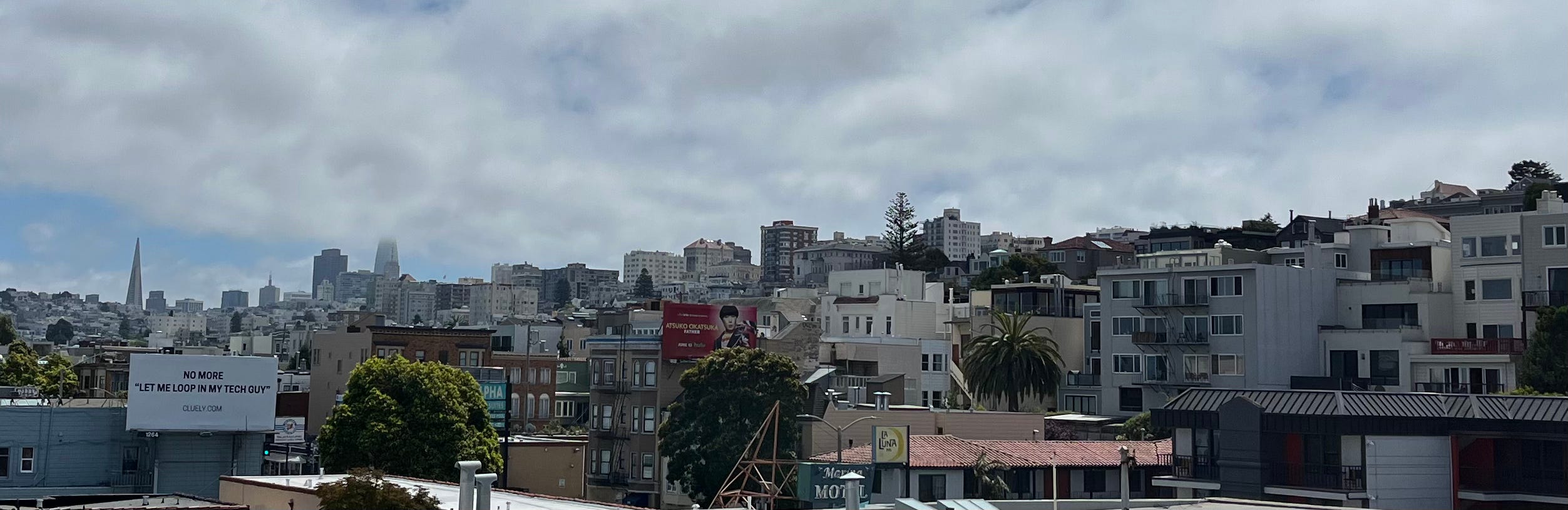
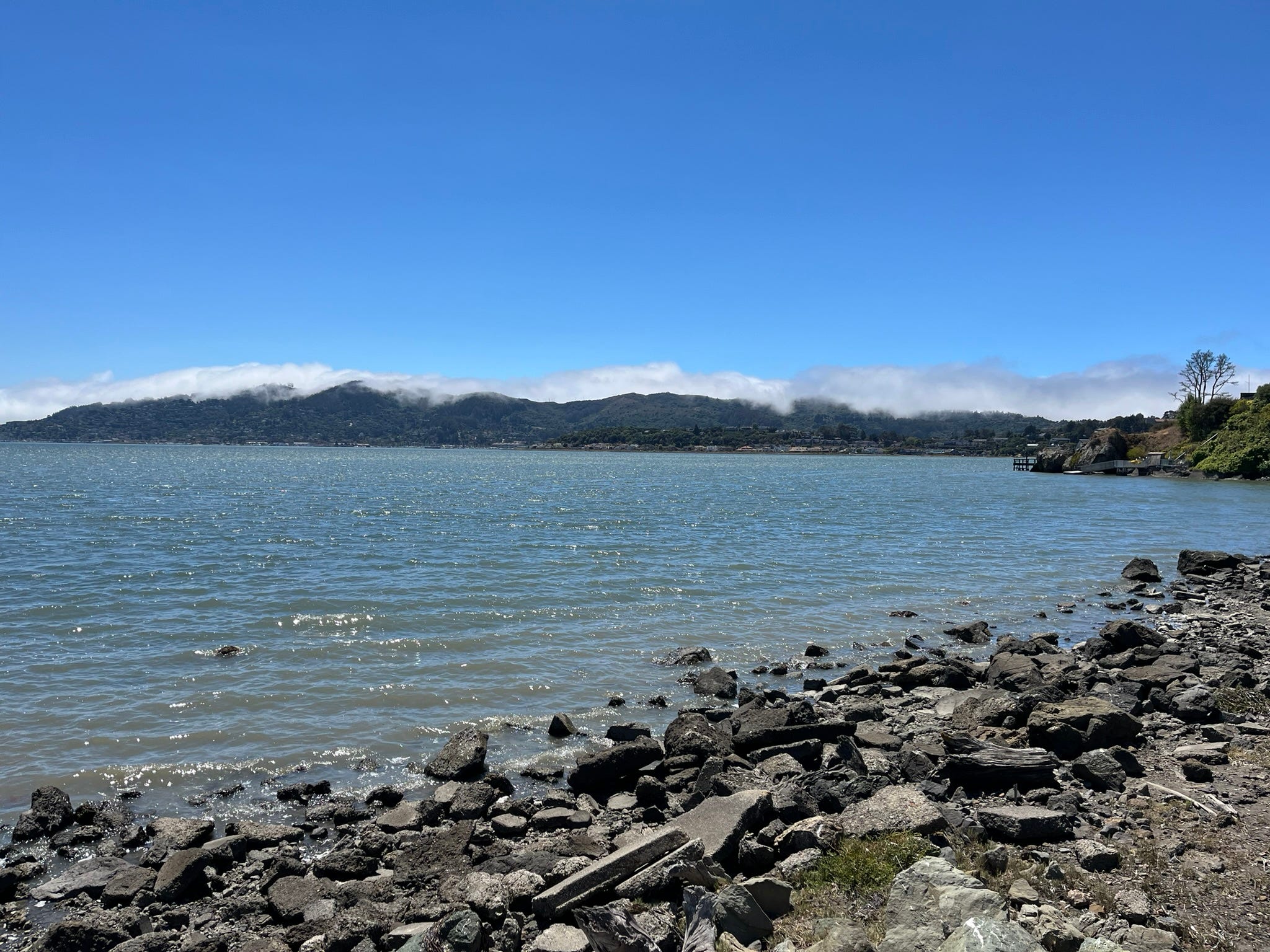
The city itself, Fox News be damned, is breathtaking as ever. Its topography is difficult to conceive for a southerner like myself: rolling mountains, sparkling ocean views, gargantuan hills, the fog (which they call Karl, I learn), and consistently unimpeachable weather. It looks and feels like paradise, and there’s no question why the richest people who have ever lived established their fiefdoms in it.
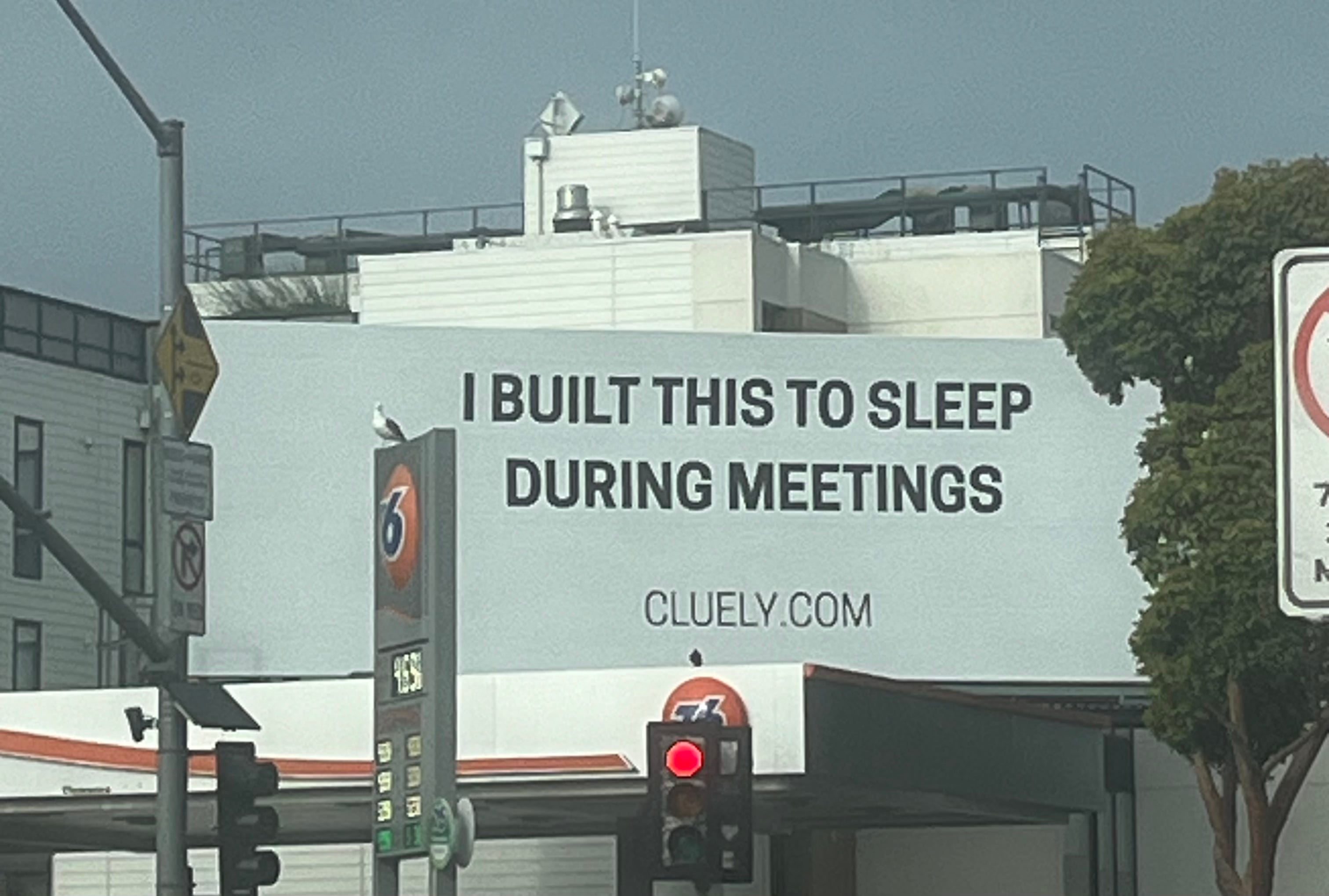
While walking around, I noticed one company taking up more physical ad space than any other: Cluely. I asked Brock about them: “They’re basically a company that a16z [the blue-chip VC firm run by Marc Andreessen and Ben Horowitz] invested $15M in because they know how to go viral.”
Their ads were black and white with block text:
“I BUILT THIS TO SLEEP DURING MEETINGS.”
“NO MORE ‘LET ME LOOP IN MY TECH GUY.’”
“HI MY NAME IS ROY. I GOT KICKED OUT OF SCHOOL FOR CHEATING. BUY MY CHEATING TOOL.”
The ”tool” in question is an AI assistant native to your device, meaning that from the minute you open your laptop, Cluely is on your screen providing notes for whatever you may be doing. The ideal use, according to the company, is to “cheat” during job interviews. It connects to your microphone and audio, so if an interviewer asks you a question, it can provide instant answers the way an LLM would if you had manually looked it up. By many accounts, it is not a good tool, with one Reddit user calling it a “half-working ChatGPT wrapper.” Ask Cluely’s backers, and they’d probably tell you that functionality is beside the point.
Cluely’s founder, Roy Lee, is the same Roy who was featured in New York Magazine’s bombshell story, “Everyone is Cheating Their Way Through College.” Throughout that story, he is painted as a firebrand visionary who wants to tear down the bureaucratic processes students are subjected to (like arduous LeetCode assessments) by harnessing generative AI. It quickly becomes clear that the success Cluely has enjoyed thus far is not a product of technical acumen, but rather, as Brock said, a penchant for virality.
On a podcast featuring Lee and two of a16z’s general partners, the VC responsible for funding Airbnb, Facebook, and Roblox, reveals that their reason for investing in Cluely lies heavily in Lee’s ability to game the algorithm. Winning people’s attention (whether good or bad), the VC posits, is more important than having airtight software. Lee has achieved this through shortform content, which, while cringey, are surprisingly high-effort and scripted.
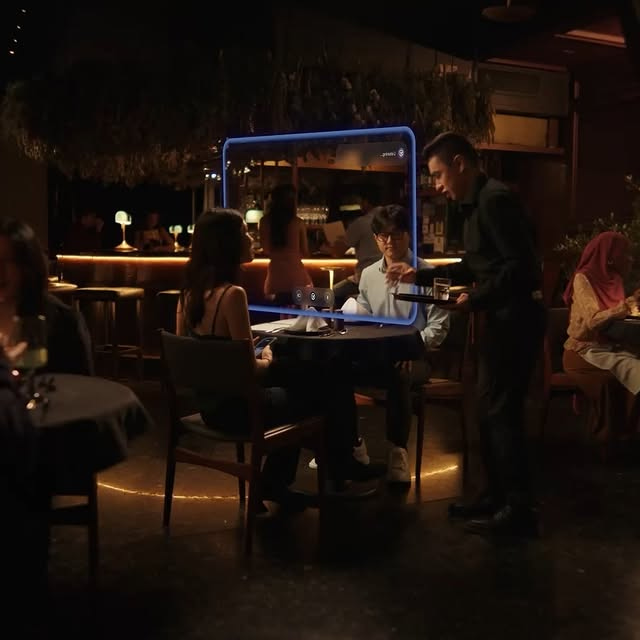
For example, he launched the company with a video that shows him “cheating” during a first date. His date questions his age and interests, and as he stumbles, Cluely provides instant information to help him get back on track with her.
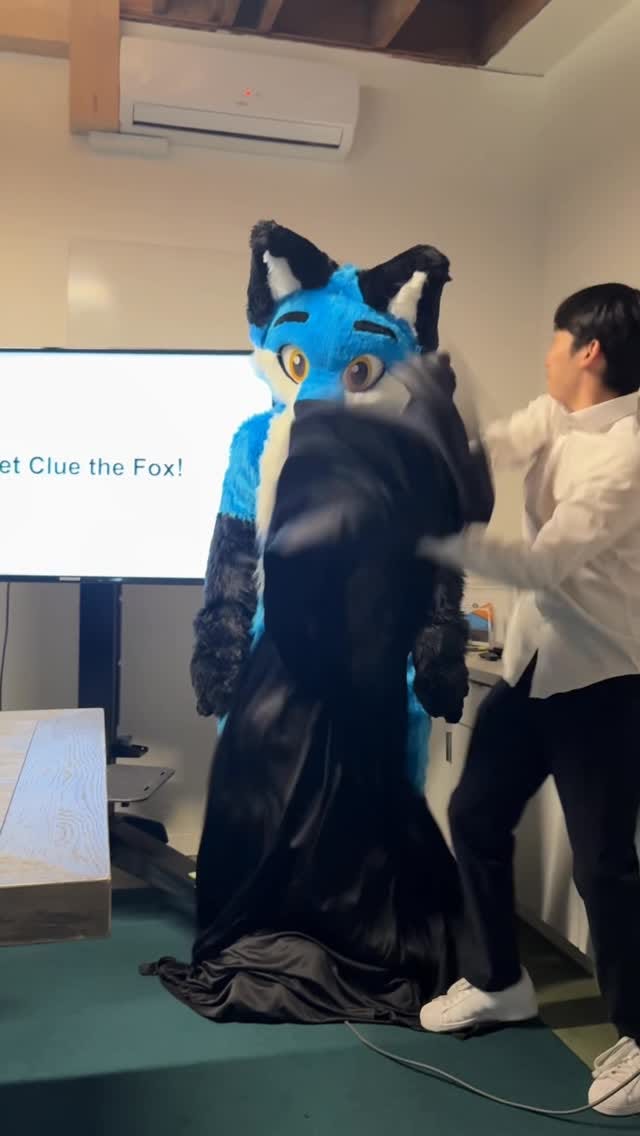

Brock tells me that he needs to start making “day in the life” videos if he ever wants to raise another round of funding. He’s only half-joking. More interestingly, as we admire the Catholic church and its surrounding junkies in SF’s Washington Square Park, he likens AI to electricity: “In its current state, AI is basically a new element. The power of the technology is revolutionary, but as a society, we’re currently figuring out how to use it, and what to use it for.”
This could explain why Cluely, and Brock, even, have had boatloads of money thrown at them. VCs are willing and able to make bad investments, so long as AI is in the tagline. If 9/10 of the companies they back fail, the one that works will more than make up for it. Like the Googles and Amazons of the dot com boom, whatever survives past the AI hype has endless potential. It’s why Softbank led a 40 billion dollar investment round for OpenAI, a company whose own projections indicate they’ll lose 14 billion in 2026 alone. Whoever comes out on top of the AI race will play a large part in determining what society looks like 50 years from now.
My understanding of San Francisco is as follows: there was the gold rush, so a bunch of people moved there and were given pairs of Levi jeans. Then Ferlinghetti and Ginsberg started talkin’ crazy and Kerouac and Burroughs got famous and all of a sudden everyone was smokin’ weed and poppin’ tabs and goin’ camping. Then Hendrix blew up Monterey and the Grateful Dead had even more people poppin’ tabs and Bob Dylan changed the world. Then the internet was invented and Apple bought the city and sold a third to Google and a third to Facebook. Then the consequences of social media and overstimulation were revealed and the fabric of society began to decay–oh, and a global pandemic hit, so a bunch of people moved out and it became a haven for junkies and thieves (professionally known as “bippers”).
As a response, everyone said “Ooohhh SF has gone to shit, the liberal mayor ruined the city, it’s over,” so the far-right sympathizing technocrats moved to Texas. But these technocrats quickly realized that it’s only fun to cosplay as Yosemite Sam when there aren’t actual Yosemite Sams around, so a bunch doubled back on that Texas move. Then boom, AI comes and SF is hot again. The city is poppin’, the money is flowin’, college students are flockin’, but the spirit is…different. The nerds’ infiltration of the most objectively beautiful city in America has been finalized. Everyone cool has been priced out. It’s swagless finessers with half of a Cal-Poly computer science degree elbowing for a view of the golden throne that Sam Altman and Elon Musk are playing musical chairs with while Jensen Huang pisses into both of their mouths from a cloud.
Brock lives in Haight-Ashbury. Locals call it the Haight (phonetically: the hate). It was the Summer of Love’s nucleus, but these days, it’s mostly a tourist attraction for people who unironically wear peace sign plastic sunglasses.. The streets are full of hippie-themed vintage stores and expensive lunch spots. Walking around, especially through Golden Gate Park–as astonishing a city park I’ve seen–it’s fun to imagine people practicing peace, love, and happiness. This isn’t the case. It’s more so “How do we increase user retention among our subscriber base” (same) and “I pay $700 a year for The Information even though the writing is boring.” Also: matcha drinkers, Chase Bank, Whole Foods, Airpods and dogs.
Brock, knowing that I love greasy spoon diners, dilapidated dive bars, and f r e a k s, was keen on showing me the “non-tech” side of the city. It’s not so much a side as it is a sliver, but this one area of North Beach, he assured me, maintains that vintage SF literati energy. So we made a plan: on Friday night, we’ll tie one on.
I had someone to see first. Not my blood brother, who lives in the city as well, but a dear friend from Eastern Asia with whom I have a blood bond. He is not a US citizen, and is currently fighting tooth and nail for a work visa, so the details of him and his company will be distorted, but the events I depict will be fact.
He works at an AI company that is strapped to a rocket ship. I won’t mention them by name, but, according to the press and my Bay Area-native cousin who works in tech, they’re perhaps the best example of a successful AI startup. They’re also one of those 9/9/6 companies–working 9 AM to 9 PM, 6 days a week–and maybe they were featured in the mega-viral WSJ piece on the stringent and boring nature of new AI companies. At 7 PM on Friday, I met my friend, who we’ll call Humbert, at his office. I biked along the Pacific, past the Wharf and Union Station, until I ended up in an industrial area full of gay clubs and bridges.
The office was the size of an artillery ship, and had the feel (and musk) of a shipping container. The grey walls let in little light, and the rows of standing desks held ample monitors and notepads. Only 40 or so people work at the company, but there is enough room in the space for at least 100. While the office wasn’t packed, it was easily the most intense work environment I’ve ever witnessed on a summer Friday.
Downstairs, we passed a ping-pong table and basketball hoop that looked like they hadn’t been touched, and made our way to the cafe. In the kitchen, stale Thai food that had been catered for lunch sat dormant, while on an oblong cafeteria table, our room temperature burgers awaited in a paper box, smushed beneath dozens of other room temperature burgers. It reeked of grease and carpet. Just outside the office, we would’ve had a perfect view of the sun sinking under the Pacific. But in this cafeteria, the golden light beaming outside had been exchanged for the clank of keyboards and cross-collaboration between multi-functional teams whose sole purpose was to inch this company towards a Great Big Exit via acquisition or IPO.
At the table, a few seats away from a group of engineers, Humbert and I caught up in whispers. He was still new to the company, and while clearly well-liked, this job was the only thing keeping him in America, which made him justifiably paranoid. He told me that he eats three meals a day in the office, five days a week. He doesn’t work on Saturdays (though some do), but on the weekdays he gets in at 7 or 8 AM and leaves at 9 or 10 PM. His role is to help bridge the gap between their sales and product teams to ensure updates are streamlined. I didn’t say it out loud, as I didn’t want the engineers–who were having an intense discussion about ChatGPT’s newest large language model–to malfunction, but it all felt terribly depressing to me.
As Humbert and I walked back to his apartment, we calculated how many waking hours per day he spends away from the office: ~ three. Two to work out, one for personal hygiene. The phrase “golden handcuffs” finally made sense to me.
In Humbert’s defense, his salary is 20% above market. He was given a generous equity plan, and he knew exactly what he was signing up for. “It is good,” he says, “because if I am to work, I would prefer to work hard.” Heading to Brock’s to kick off the night, we agreed that we’d both take a load off this weekend.
Months ago, my heart warmed when I learned that Brock and Humbert had become close friends. I was Humbert’s unofficial American liaison some six years ago, picking him up from the airport when he first touched our soil, and living with him in an attic apartment as he studied here. I took him home in November 2019 so he could experience his first Thanksgiving, and on our way to Atlanta, we stopped in Mississippi to visit Brock on a particularly rowdy weekend of SEC football. We had a 48-hour bender that was disorienting by even my standards; since then, Humbert had affectionately referred to Brock as “Seth Rogen.”
We showed up at Brock’s with 12 beers (paid for by Humbert: “Millan, please. I have spent zero dollars this week”) and got busy. Brock’s girlfriend had some friends from Texas visiting, so we headed to North Beach six deep, landing at Vesuvio Cafe. Sharing “Jack Kerouac Alley” with City Lights bookstore, it’s a gorgeous two story building full of wonky paintings and newsclippings of the Beat heyday. More importantly, it was full of people! Right away I was convinced: Yup, San Francisco’s still got it, counterculture is in good hands! We had a great 15 minutes, until the energy shifted.
It became clear that Vesuvio’s enchanting exterior was a siren song. It drew us in with glee, then turned us into versions of ourselves more sick and twisted than we could ever conceive. Smiling faces turned to scowls; the stained-glass windows struck thunder and muck down on our table. Everyone started to argue. Couples were at war, shooting darts dipped in snake venom into each other’s eyes. Humbert said there was no way we could microdose shrooms and drive eight hours later. I said that driving is literally the easiest thing in the world, and that it could be done on much more than a microdose. Brock’s girlfriend, who works as an occupational therapist for people who are disabled from car wrecks, did not take kindly to that suggestion. Gin with a side of Modelo was a terrible decision. My girlfriend called me: it was 3 AM in Chicago and her Uber had crashed. I looked across the bar and saw her opps from New York waving at me. I asked ChatGPT how to escape this hell. It told me to go to the top of the Salesforce Tower and repent loud enough for the data centers to hear me. I climbed all 61 floors but my two-factor authentication failed. I walked back to North Beach with eyes cast down, dreading my fate.
We ended the night at Sam’s Burgers, a late night spot heralded years ago by a belligerently drunk Anthony Bourdain. Here, it became clear that a side effect of the great Tony’s martyrdom is that his inebriated words have given some mediocre spots undeserved ego boosts. The second we ordered $80 worth of greasy food, we were treated like swine. Yes, it was 2 AM, and yes, the girls we were with started twerking and causing a ruckus. But to cement yourself as a haven for hungry drunks and not treat this situation with some sort of leniency is a grave offense.
As the girls danced and sang along to “Who Let the Dogs Out,” the cashier told us to wait outside for our food. I stared at him blankly and didn’t move an inch. Brock stayed with me. Humbert and the girls went outside. 15 minutes passed with no sign of food. Humbert went in and asked the fry cook if our food was ready. The fry cook was a stringy Lebanese-man with shriveled skin and a face that looked like Rango’s. From the corner I was standing in, I watched the beginnings of an altercation. Humbert is a no-nonsense guy, and, with him not being an American, his demeanor can come across as pushy to some. Yet still, the response was unwarranted: the fry cook practically spat at him with his forked tongue. “I don’t fucking like you standing there, get your ass back outside. The food will be ready when I say it’s ready.”
I followed Humbert back outside. He was fuming mad. His anger was contagious. I began to shout curses at Sam’s. I rallied for a group piss session on their entrance. We wanted blood. Brock tried to cool us down, but that led to another argument with his girlfriend, who told him he should be supportive of his friends, even when raging blindly. Humbert began to chant a mantra to justify his anger to the small audience that was forming: “I have been treated unfairly. I have done nothing to deserve this.” I said it too. The crowd joined us. As a dozen of us approached their glass windows with brass knuckles, Brock came out with the food.
We ate our burgers outside. They were fine. Right after we finished up, the same cashier who kicked us out earlier told us we had to get up. He was putting the tables away for the night. Nobody moved. Humbert pursed his lips and shook his head: “No, we will not move. We are perfectly fine right here.” He stood over our table and stared at each and every one of us. Nobody budged. Two minutes of this tension. Our Uber arrived. The minute we got up, the cashier stepped up to Humbert. “What’s your fucking problem, man?” Humbert got in his face and started shouting, I joined in too. They were chest to chest, and I was itching to handle the fry cook while Humbert took the cashier. Brock pulled us into the Uber right before things exploded.
I laid off the chaos for the next few days. A long bike ride from the Golden Gate Bridge to Tiburon, stopping in Sausalito to look at the houseboats and sit on the chair where Otis Redding wrote “(Sittin’ On) The Dock of the Bay.” Another long bike ride to the surf-dive-meets-honky-tonk called The Riptide for some live music.
A short linkup with Atlanta rapper Corporate Lingo, who, having lived in SF for five years now, explained that the “counterculture” in SF exists in the outdoor community, as they’re super hardcore about camping, biking, and climbing. Also, he said that Larry June hangs out in North Beach a lot.
I walked aimlessly, passing fent smokers in the Mission who huddled outside of a $1500 a month co-living space, a few tent cities in the Tenderloin, the hustle of Chinatown, the technotopia of the Marina, and the fog-covered beauty of Pacifica. I launched Derange. I edited Ock’s massive slapper. I had that founder’s energy running through me. I had yet to figure out how to incorporate AI into our business model. My SF exposé, BOOMTOWN, USA™, didn’t have the juicy reporting I was hoping for. I was leaving town in two days. My company’s ARR wasn’t even close to seven figures, and I had secured $0 in funding. I started to feel like I wasn’t cut out for the crazy future that awaits us. Hope was slipping, until Humbert reached out.
He invited me to his company’s Series A launch party. They had just announced $24M in funding led by a16z, and were holding a private rooftop event to celebrate. Game on. Brock knows all about his company, and was keen on attending to network with the investors who were bound to be there in droves. He said we should wear dirty hoodies so everyone knows we’re legit. He said that in San Francisco, the worse you dress, the more money people think you have. I told him we better put on our nice clothes if that’s the case.
So there Brock and I were, sipping gin martinis with a twist, overlooking the city as the sun began to set, pretending, for a moment, that we had finally made it. When the founders who raised 24 million dollars arrived, we were quickly reminded that we hadn’t. Their outfits screamed “Big Lots,” with pants either hanging far above or below their ankles, their shirts all wrinkled, probably from sleeping on the office floor. Brock and I had ironed collars, pants that fit great, and even tied shoelaces. A reminder of our lowly place on the totem pole.
We brushed that scarlet letter off and began to network, and boy, did we ever. Just about everyone I spoke to was either a founder, an investor, or an intern from Harvard or Stanford spending their summer in SF. One woman, a fellow Georgia-native, had founded a company for AI sunglasses and recently gave up her role as CEO to enjoy nature and rest on her laurels. Another was the founder of a particular Hacker House–a shared living space for coders/founders–which everyone around me seemed to be quite familiar with. Another guy, merely 25, was a serial founder whose first two companies had failed. He just moved back to SF from Dubai, and with the AI boom, was gearing up for his third launch and felt more optimistic than ever. A very pedestrian looking guy turned out to be the founder of an AI apartment leasing company that had raised about $11M. He allowed for some sleuthing.
Q: Are most of these startups just ChatGPT wrappers with niche packaging?
A: Kind of, but not really. They’re more-so ChatGPT wrappers with intensive prompt engineering built underneath, and then niche packaging on the outside.
Q: Do you think AI will take everyone’s jobs? Are you worried about that?
A: Eventually, yes, it will take most jobs. But by that time, I hope to be sailing off into the sunset.
He was a seasoned founder, so I introduced him to Brock and they talked shop for a while. I met a sales guy who was new to Humbert’s company. He popped a Zyn and was more than happy to chat. He had just moved to SF from a small midwestern city, and was super hype about the Hinge scene.
“Out here, bro, money talks. The girls back home, man, I’d have to take them on three or four dates before they’d let me crack. But here, if I spend $300-400 on a date, they’ll let me do whatever I want.” He was drinking heavily, and one of the company’s founders came up to remind him that he had 10 demo calls tomorrow. “Literally from 7:30 AM to 2:00 PM I’ll be running customer meetings nonstop.” I asked if he’s worried about a hangover. “Nah man, I’ll just rip a few Celsius’ and lock in.”
About an hour and a half in, Humbert arrived. He had just finished up at the office, and wasn’t drinking because he had to be at work early the next day. He, Brock and I devoured some sushi and skewers, then his founders gave a speech about how far the company had come. They shouted out their investors who came, and I think everyone in attendance, myself included, kept note of who they were so they could make sure to pitch them later. I tried my hand.
The tough part about Derange as a business model, is that our core business–writing–is about a century late to the fold. So at first, I stumbled a bit: “It’s like, really long, immersive cultural journalism. And it’s about everything. We basically aim to capture the world.” Right…
Soon, though, I found the key: Substack. The eyes of the poorly dressed lit up when I mentioned the platform. Yes, Substack is the way to go, they said. I guess this shouldn’t be too surprising: Substack’s latest valuation after a $100M round of funding amounted to $1.1B, effectively making them a unicorn. Also–a16z was an early investor. (The intelligence of a16z’s investment team was recently put into question, as they denied Derange’s application for $1,000,000.)
I had no bites, yet I did have some juicy tidbits for BOOMTOWN, USA™. I was determined to get to the bottom of that well. Around 11 PM, the party thinned out, and the bar signaled last call. Everyone who remained was nice and tight, Humbert had already left, and Brock was on his way out, too. I stuck around.
About 15 people, mainly C-suite and top investors, were making plans for an afterparty. I tagged along. We walked about twenty minutes to a cozy dive bar full of rough-cut locals and taxidermied beasts tacked to the wall. The head of sales walked in and demanded the bar be lined with shots of Casamigos. He ensured that everyone had a drink in their hand, then stood up on a wobbly barstool and made a speech.
“Everyone! Everyone! If you’re in this room, just know that you’re part of something bigger than yourself. Whether you’re a customer, an investor, or an employee, know that you shaping the future every single day with the work you do. This is only the beginning for AI, this is only the beginning for us. I don’t know about you, but I can’t wait to see where it leads us. Cheers to yourselves, cheers to Series A, and cheers to a future paved by AI!”
How could you not drink to that?
Silicon Valley exposed! Money with no meaning, people with no purpose, build exit repeat. Great work 🫡