

Abdulla's Apprenticeship
A Syrian refugee comes of age in a far-right stronghold of Germany.

Jeffrey Arlo Brown is a journalist based in Berlin. His work has appeared in the New York Times, The Baffler and other outlets.
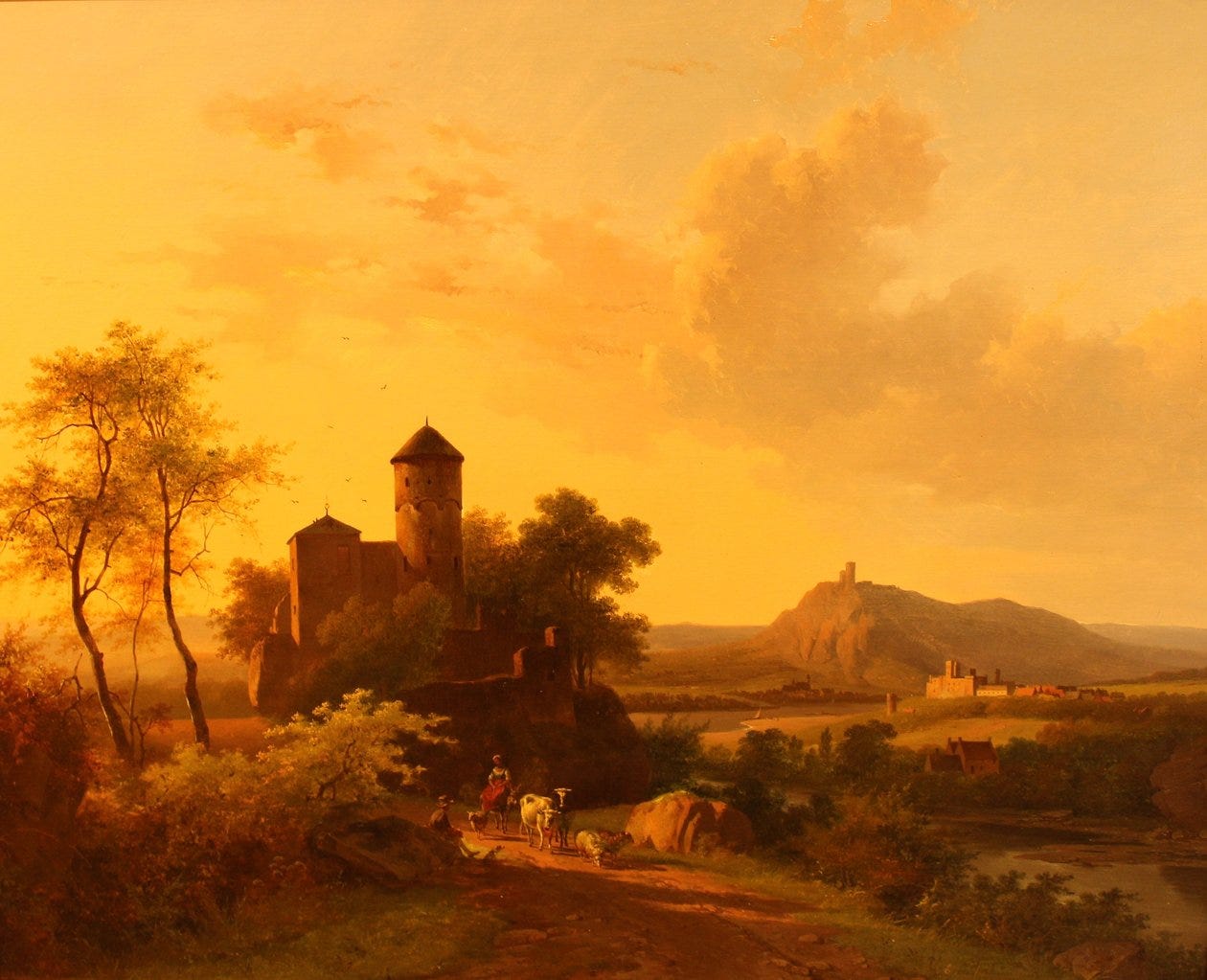
The house that Abdulla’s family left behind had three rooms. The walls were painted in warm colors and decorated with drawings by his father. The kitchen was blue, and everything in it was exactly as Abdulla’s mother, Majd, wanted it to be. From the balcony, she could see across Daraa, Syria, to her husband’s office, where he worked at a university teaching drawing to aspiring architects. It was every woman’s dream, she joked, to be able to watch her husband while he was at work. Abdulla, who was six when his family left their home, remembers the big windows in the children’s room.
In March 2011, a group of teenagers in Daraa were arrested for spray-painting graffiti with Arab Spring slogans. The locals protested, and soon, the Syrian army began a ten-day siege of the city as the rest of the country hit the streets. That earned Daraa a new title: “the cradle of the revolution.” Abdulla, his parents, and his sisters went to stay with relatives in Ammann, Jordan. But they could sense that a bright future in their conflict-ridden home was unlikely.
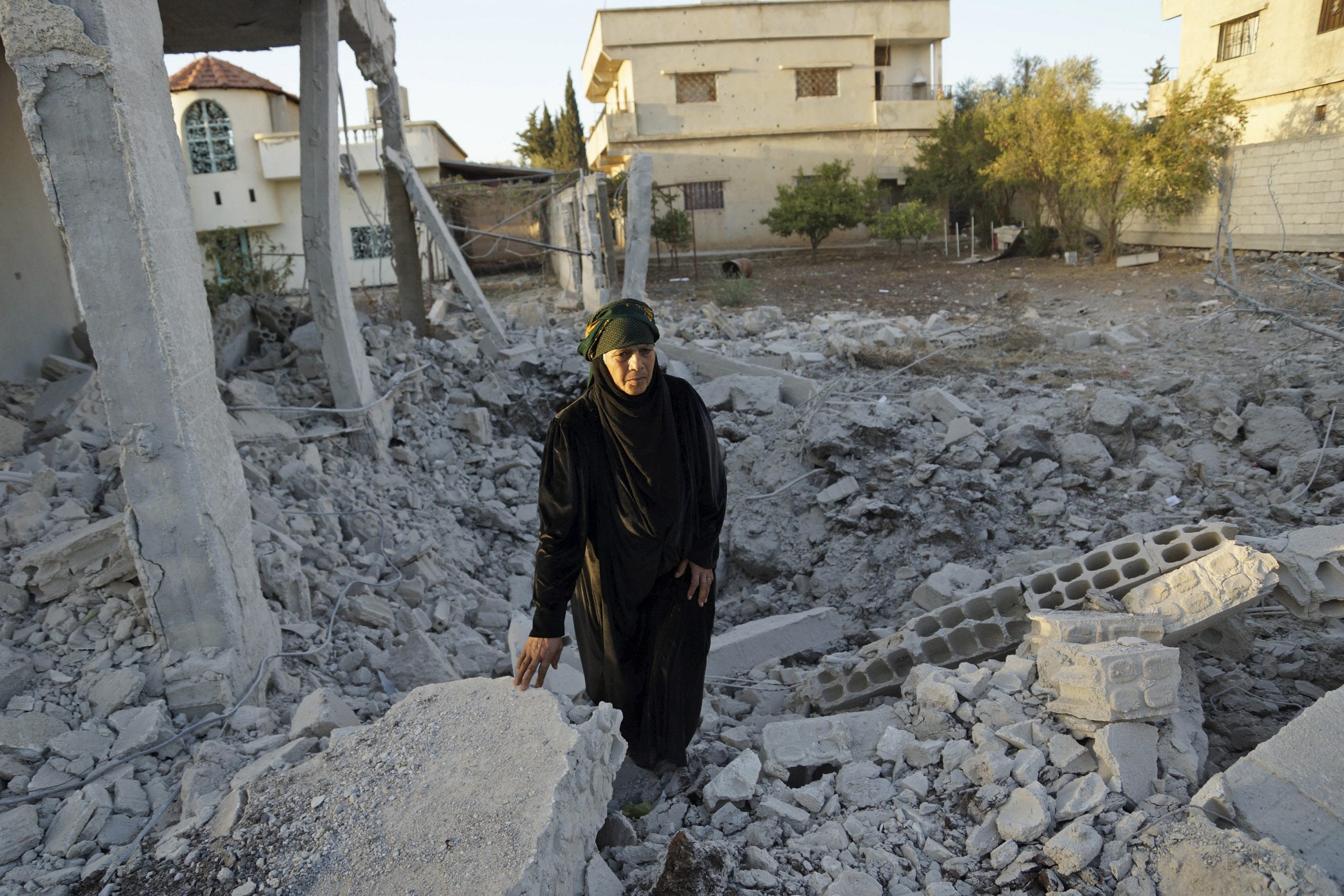
They applied for asylum in Germany, and in 2016, Abdulla’s father traveled alone to Rudolstadt, a small city in the state of Thuringia in the former East, to handle their paperwork. When the rest of the family arrived – along with over 700,000 Syrians who came to Germany that year – they settled in a town called Saalfeld.
By then, Thuringia was becoming an epicenter of Germany’s growing far-right movement, catalyzed by the arrival of families like Abdulla’s. Marches organized by a local branch of the Dresden-based movement “Patriotic Europeans Against the Islamization of the Occident” began appearing in Rudolstadt and Saalfeld as early as March 2015. In 2019, hundreds of torch-bearing demonstrators descended upon Rudolstadt, rallying in anticipation of “the battle to save our fatherland.” In 2024 state elections, the Alternative for Germany (AfD) party, which has advocated for the forced deportation of “non-assimilated” German citizens of different heritages, won 32.8% of the vote — nearly ten points more than the second closest party. In 2017, Björn Höcke, a 53-year-old former teacher who leads the Thuringia branch of the AfD, was found guilty of knowingly using an illegal Nazi sturmabteilung slogan in the classroom. (“Alles für Deutschland” / “Everything for Germany”.) Just last year, a local domestic intelligence agency officially considered the AfD to be a right-wing extremist group.
A recent survey puts the AfD at 37% in Thuringia. Families like Abdulla’s, who arrived among a wave of goodwill — at least in liberal cities — now find themselves targeted by rising populist tides. “We are running to make our country what it was before 2015,” reads a recent AfD Thuringia newsletter. “Our home, in which we feel safe.” In other words, a place without Abdulla.
The broad assumption that “German” refers to a nationality and an ethnicity ignores the country’s rich history of immigration after World War II. Between 1955 and 1973, 14 million “guest workers” from places like Italy, Turkey and Portugal helped rebuild the bomb-ravaged West, often toiling in harrowing conditions. In the 1970s and 1980s, Vietnamese immigrants from Communist North Vietnam and workers from Mozambique came to work in East Germany, while Boat People fled to West Germany at the end of the Vietnam War. In the 1990s and early 2000s, refugees arrived from the Balkans. An East German professor of mine used to joke that without immigrants and their flavorful dishes, the city of Berlin would have long died out, wasted by grim Prussian food.
After the fall of the Berlin Wall, East Germany faced a wave of violent racism. The era is now known as the Baseballschlägerjahre, or “years of the baseball bat.” In 1992, a mob of extremists threw rocks, bottles and Molotov cocktails at Vietnamese immigrants living in Rostock-Lichtenhagen, trapping them. The pogrom completely overwhelmed the unprepared police.
After a period of relative calm, the arrival of families like Abdulla’s in 2015 and 2016 resurfaced old grievances. There were anti-Muslim demonstrations, attacks on refugee housing, and the rapid rise of the AfD, a formerly fringe party grounded in opposition to the euro. A man who murdered nine non-ethnic Germans in cold blood in Hanau in 2020 was found to have watched speeches by Björne Höcke online the day before the crime.
In recent years, Germans have become more sensitized to the subtleties of immigration and identity. Yet progress is halting. In October, Chancellor Friedrich Merz — who leads the CDU, Germany’s leading centre-right party — said, in vague reference to immigrants, “We still have this problem in the way the cities look.” Even in liberal circles, the term of art for non-ethnic Germans is Menschen mit Migrationshintergrund. “Person with a history of migration.” That’s a lot of letters for “German.”
By now, of course, Saalfeld is Abdulla’s home too. He’s lived there longer than he lived in both Daraa and Ammann. He’s a German citizen, and he speaks the language with a light Thuringian accent. Yet still, he gets looked at like an alien when he’s out with his mom, who wears a hijab.
Now 19, Abdulla is coming of age in a country that seems increasingly unsure whether it wants him there. His adolescence has paralleled Germany’s fraught transition, from being rendered homogeneous by the Holocaust to becoming a modern, multiethnic state—a process accelerated, in large part, by the German government accepting far more Syrian refugees than other large European states. Now, it seems that many of Abdulla’s neighbors want to turn back the clock.
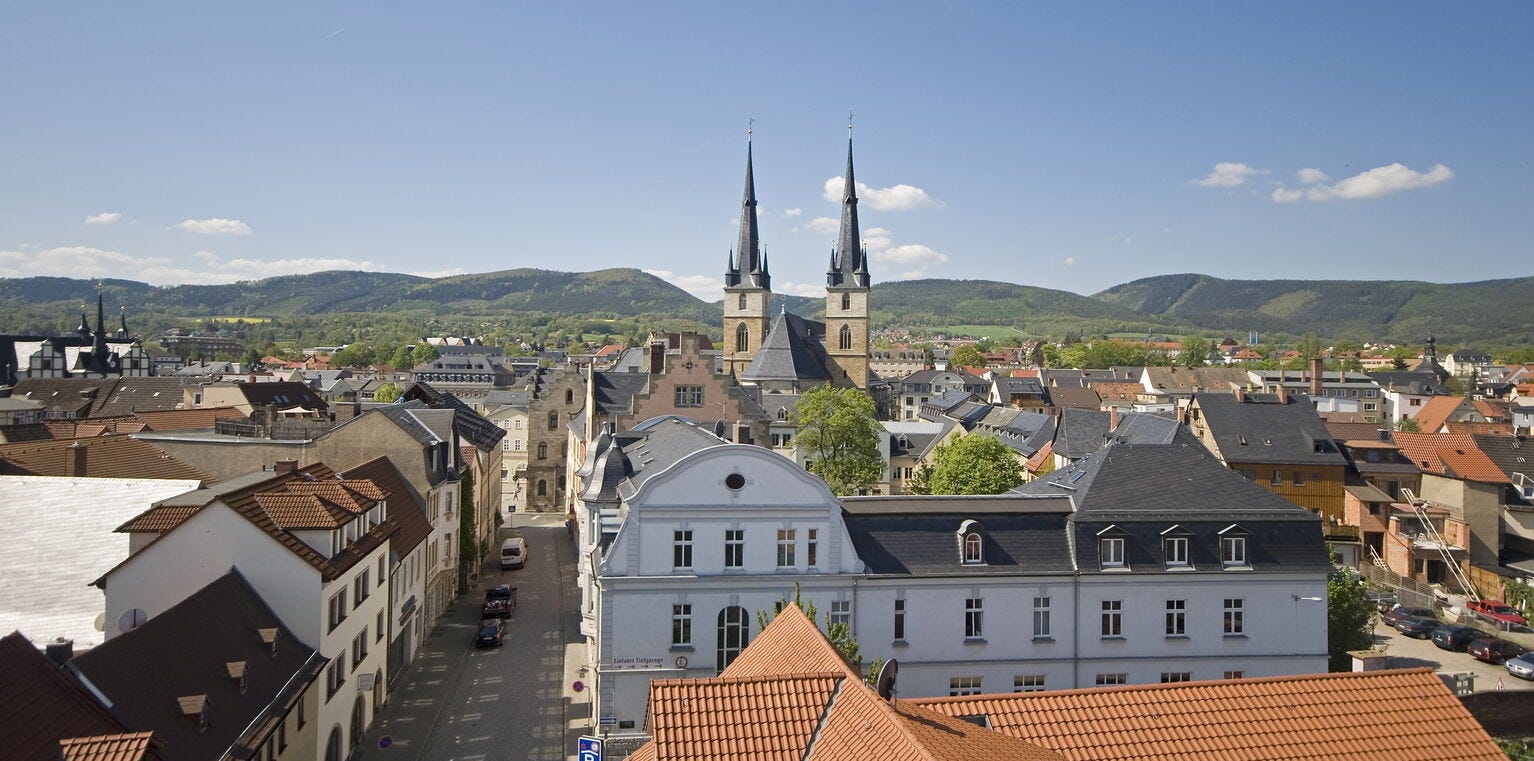
I first met Abdulla in April. It was a sunny day, and brass band music wafted around Saalfeld’s market square. The pretty, historic town of 30,000 people defies the stereotypes of post-Soviet decay that often cling to the former East Germany: fields of sunflowers and wheat, cobblestone streets, quaint shops decorated in pale greens, yellows, purples and reds, and well-preserved early Renaissance architecture, including a town hall building that dates back to 1537. We sat down for a lunch of the blandest Indian food I’ve ever tasted, a meal clearly adapted to the local tastes. He presented himself as a confident and outgoing kid; he wore a necklace with an Egyptian symbol and spoke with the practiced eloquence of the second-generation immigrant.
Abdulla started his German schooling in fourth grade. Almost immediately, he was met with flashes of rejection. He remembers one girl who always gave him a wide berth in the hallway. He found out later that she was afraid she might touch his skin. In fifth grade, when he spoke more German and had more friends, he became somewhat of a bully. “At some point, I turned the tables,” he said. It was like an instinct: He was making sure he didn’t become a perpetual victim. As a result, he was in the principal’s office once per week.
In sixth grade, a boy whom Abdulla didn’t like was talking to himself out loud in the classroom. Abdulla went over to his desk and told him to shut up. The boy gave Abdulla a dirty look. Abdulla raised both hands and hit the other boy on the head with them. In response, the boy grabbed a pair of scissors and stabbed wildly. He punctured Abdulla and one other. In the uproar, nobody noticed that Abdulla had a pair of scissors stuck in his shoulder. He took them out and went home from school with an open wound. Abdulla was suspended for a week.
German schools are separated into three tiers; only those who graduate from the highest, called gymnasium, can progress to university-level studies. Abdulla had been placed in a lower track. It was becoming a matter of urgency for him to go to gymnasium. “My parents told me, if I stayed at the regular school, I’d become a criminal.” Majd felt powerless to help her son, but she went to the principal’s office anyway, urging him to help Abdulla get into a better school.
Her efforts paid off, and in seventh grade, when Abdulla started gymnasium, things improved quickly. He continued to have moments of minor adolescent rebellion, like smoking cigarettes in the school building. (“I’m telling you that reluctantly,” he said. “It’s really embarrassing.”) He also quickly accumulated the marks of a thriving high school student. He got better grades, developed a wide circle of friends, and even got a car. He became popular. But he could not remain unaffected by the rise of the far right in his home. It had a way of getting into everything, of polluting the atmosphere like sooty air.
I got to know Abdulla through Bert Carlsen, a tall, charismatic geography teacher who had him as a student in tenth grade. Carlsen grew up in East Germany and trained to become a teacher under the auspices of the Socialist Unity Party. He was always an independent thinker, though, the kind of person who appreciated Marx but loathed the turgid ideology of his “scientific Communism” courses. He taught in Saalfeld from 1988, when Thuringia was still part of the GDR, up until his retirement last year. Since 2010, he has observed the slow but steady rise of the far right in the region with concern.
Carlsen lives in Pößneck, a smaller town about 12 miles from Saalfeld, and a place where Abdulla feels yet more conspicuous than at home. On a recent evening, I drove past streets named for Pushkin and Engels to meet Carlsen at his house. The AfD’s rise there has been accompanied by a sense, familiar from GDR times, that one must watch what one says. “It’s a kind of latent feeling,” he told me, “that developed over time.” He added, “It is a burden in a region like this one, and it’s becoming more of a burden all the time.”
He recalled planning a project to repair his roof with a local construction company. Carlsen and the roofer spent hours discussing specifics. But as their conversation drifted to other topics, Carlsen politely pushed back against some AfD talking points the roofer brought up. The roofer abandoned the project and ghosted Carlsen — until the day of Trump’s reelection, when he sent the teacher an AI-generated video of Trump bashing members of the German Green Party with a hammer.
Driving around Saalfeld, I saw half-hidden allusions to far-right sympathies. In Pößneck, a man wore a hoodie bearing Ruhm und Ehre (glory and honor), a phrase loosely associated with the Waffen-SS — the Nazi paramilitary organization. Other times, the references have an American twist. Near Saalfeld I saw a rear windshield sticker with the unwieldy QAnon slogan “WWG1WGA” (“where we go one, we go all”). In a quaint mountain town of Saxony, which borders Thuringia to the east, a parked truck in military green displayed a plush toy of a Klu Klux Klan knight on the dashboard.
While Abdulla has faced some severe incidents of racism, mostly, he deals with profiling and nagging reminders of difference, experiences that, beneath his easygoing demeanor, have festered like an infected splinter.
There was the time he was at a friend’s 18th birthday party and a relative came by to say hello. All his friends introduced themselves. He said his name was Abdulla. “Yeah, I can tell,” the uncle told him, and walked away.
There was the time his neighbors were having a garden party, drinking outside his apartment. He introduced himself to one of his neighbors’ friends, who told him, “No, no. I’m too tipsy for a foreigner,” and ended the conversation.
There was the time he was hanging out with a friend who was dating somebody in Pößneck. Abdulla calls peers “brother” a lot — it’s a well-established part of German youth slang, especially among kids of Turkish and Arabic heritage — and said it to one of the Pößneck teenagers. “I am not your brother,” he replied.
Abdulla is certain that of the 23 kids in his class, six would vote for the AfD. When he was having a rough day at school, some kids joked, “When are you coming by with a truck?” — a reference to a 2016 terror attack by a Tunisian citizen who drove a truck into a Christmas market in Berlin, killing 11 and injuring over 50, or perhaps a 2024 attack by a Saudi Arabian citizen who drove a car into a Christmas market in Magdeburg, killing six and injuring almost 300. (Abdulla could laugh at the black humor of that.)
Abdulla got to know a friend’s family. “Her mom loves me,” he said. “We always had the best conversations. Sometimes I’d go to her place and talk more with her mother than with her.” Nevertheless, Abdulla learned through his friend that her mom votes for the AfD. He has begun to take such paradoxes in stride. “I wasn’t even angry at her,” he said, “because I think, ‘Man, if I’d get angry about that, then I wouldn’t have any friends left in the end.”
The next time I visited Abdulla, he had just passed his Abitur, a nationwide exam that determines a student’s university future. He did well. Majd was proud. She cried, as she did when I asked her to describe the home they left in Daraa.
Abdulla’s senior class hoodies read “Abikropolous: The Gods Leave Olympus.” He helped organize bake sales to pay for the Abiball, the German version of prom. After the official portion of the celebration, with parents present, the kids went to a bar called the Johannes-Klause. They thickened the air with their cigarette smoke. “It was like a fog,” Abdulla said. “You could hardly see anything.”
In the spring, he got a job as a street canvasser representing the World Wildlife Foundation, leaving the cozy claustrophobia of Saalfeld for Göttingen, a university town in the center of Germany. In long training sessions, he learned how to make the coldest of sales: accosting passersby and convincing them to donate money regularly. It was tough work, with long shifts and strict sales targets. He had two bad days on which he didn’t secure enough signatures. That was too many. He got fired. It was first experience working out in the real world, and he’d lasted a week.
Yet he returned home with some positives. He met a girl and worked on a diverse team: one of his colleagues was a Black German, and his boss had a Vietnamese background. “It wasn’t a topic among them at all,” he said. “They really didn’t care.” He had experienced a modern, multiethnic Germany, where having family from elsewhere was completely banal. At work, a man walking by told him, in Syrian Arabic, that men shouldn’t color their hair and Abdulla felt a pang of thankfulness that he was German now.
He spent that summer at home, looking for work. He applied to 37 jobs and didn’t get any. He wondered whether that was because of his name or his lack of connections: His peers were getting gigs through their parents. Instead, he spent his time going out with friends. I asked Abdulla what “going out” meant in Saalfeld, a place that is usually deserted by 8:30 p.m. on any given Saturday night. “It’s a good question,” he answered. “Going out means freezing your ass off because there’s nowhere you can go. Going out means not finding a place to go and then driving around a bit and walking around a bit, because there’s nothing here. Or,” he concluded, “chilling in somebody’s basement.” At that moment, he wasn’t a Syrian refugee caught in a rising tide of hatred and ethnic tension. He was every teenager ever.
In November, Abdulla got a job at the checkout counter of Aldi, and Majd had Carlsen and I over for an elaborate dinner including kibbeh, kofta and fatteh. The former student and teacher, now relieved of professional distance, spent most of the dinner reminiscing about school. They talked shit about mutually disliked classmates and colleagues. They recalled the time Carlsen spent an entire class debunking COVID-19 misinformation and lamented that there was no one left to maintain a climate change website he’d built.
Abdulla asked for advice about what to study in college. He is interested in international business management, pharmacy and maybe psychology. Carlsen gently prodded him to think about his major in terms of the things that interest him about it, rather than its career prospects. Addressing Carlsen, Abdulla kept switching between the formal Sie and the informal du. They were no longer teacher and student, but not quite friends either. They were also in similar places of flux: Abdulla, a youth poised to leave his home yet again, this time for university; Carlsen, a retiree ready to move on. They both loved this place in their own ways, but they weren’t sure it loved them back. Their country – and mine – was poised between its future and its past.
Both have strong spines and little patience for the arbitrary exercise of authority. Carlsen was telling Abdulla that when he started teaching at the school in Saalfeld, in the early 2000s, the principal was a strict Catholic woman.
“I always got in her hair,” Carlsen said.
“I didn’t even exist yet back then,” Abdulla answered.
“I always said they were the Catholic Taliban.”
Abdulla laughed long and hard at that. It was a bright and soothing noise.
Moving. The descriptions of their suroundings are so vivid, it makes you wonder about the power of memory. I'm a booklover and always try to imagine the settings; this piece really brings it to life. Such a powerful start to Abdulla's story.
Really enjoyed this after visiting Germany for the first time recently!